Infor is an enterprise software vendor, headquartered in Atlanta, Georgia, that has been a wholly owned subsidiary of Koch Industries since 2020. Koch, an Infor investor since 2017, completed its purchase of the remaining portion of Infor from Golden Gate Capital on 31 March 2020. Infor sells ERP under the CloudSuite brand, and it is one of the few remaining large ERP vendors that is privately held rather than publicly traded.
The first thing worth clearing up is the naming, because it confuses almost everyone who researches this vendor. There is no single product called “Infor ERP.” Infor sells several ERPs: M3, LN and SyteLine underpin its manufacturing and distribution CloudSuites, Infor Financials & Supply Management (FSM) serves service industries, and its product list still includes older ERPs such as VISUAL, XA, LX, System21 and Fourth Shift. Industry names do not map one-to-one to a single ERP: Infor also markets SyteLine for aerospace and defense, automotive, and food and beverage, so always ask which ERP sits under the CloudSuite edition you are quoted.
This review covers what each engine is for, what Infor actually costs (the vendor publishes no list price, so the numbers below are triangulated from implementation partners), where the product genuinely leads, and where buyers consistently report problems.
Current release: Infor ships on a named release cadence rather than a version number buyers can shop by, on a bi-annual cycle for major releases. The latest is the 2026.10 release, announced on 6 October 2026. The one before, 2026.04, took the Industry AI agent library past 100 agents and enhanced the Agentic Orchestrator; Infor says those orchestrator enhancements are in limited availability.
What is Infor Cloud ERP Software?
Infor cloud-based ERP (M3) is a highly customizable, easy-to-use, and comprehensive Enterprise Resource Planning system that enables businesses to manage their operations in one place.
It provides valuable insights into all aspects of the supply chain, from development to production planning, manufacturing execution, and delivery management.
It also helps organizations achieve visibility across their entire business and streamline processes for better performance.
Infor M3 vs LN vs CloudSuite Industrial (SyteLine)
These are different code bases with different origins, not editions of one product. M3 came from Movex and joined Infor with the Lawson acquisition in 2011, LN came from Baan (acquired in 2006), SyteLine has been with Infor since 2005 and became the base of CloudSuite Industrial, and FSM is the former Lawson S3, renamed in 2016. Infor runs M3 and LN as multi-tenant cloud ERPs on AWS and wraps them all in the same CloudSuite branding, but underneath they remain distinct systems with distinct data models. Picking the wrong one is an expensive mistake to unwind, so it is worth being precise.
| ERP | Origin | How Infor positions it |
|---|---|---|
| M3 | Movex, then Lawson M3; Infor since 2011 | “Purpose built for fashion, food and beverage, chemicals, distribution, industrial manufacturing, and equipment companies” |
| LN | Baan; Infor since 2006 | Complex, global, project-driven manufacturing; Infor cites more than 1,500 discrete manufacturing customers in aerospace and defense, automotive, high tech, industrial manufacturing, and engineering and construction |
| SyteLine (CloudSuite Industrial) | Frontstep and MAPICS; Infor since 2005 | “Purpose-built for process and discrete manufacturing”, including industrial manufacturing, food and beverage, automotive, and aerospace and defense |
| FSM | Lawson S3; renamed in 2016 | Finance, supply chain and HR workflows for service industries |
Industry alone does not settle the choice, because Infor sells more than one ERP into most manufacturing industries. Start from the shape of the business: LN for complex, global, project-driven discrete manufacturing; M3 for the fashion, food, chemicals, distribution and equipment businesses Infor builds it for; SyteLine for process or discrete manufacturers in the industries Infor lists for it; FSM if you are a service organization. Then get the ERP behind the edition you are quoted confirmed in writing.
One consequence buyers miss: because these are separate products, a capability that exists in LN is not automatically available in M3, and third party add ons are rarely portable between them. Check that the specific feature you are buying for exists in the engine you are being quoted, not merely somewhere in the Infor portfolio.
Infor Cost
Infor publishes no list price. Every deal goes through an RFP with Infor or an authorised partner, which means the only usable figures come from implementation partners who quote this software for a living. The ranges below are triangulated from those sources and should be treated as a planning envelope, not a quote.
| CloudSuite edition | Indicative license cost |
|---|---|
| Financials & Supply Management (FSM) | $100 to $200 per user per month |
| CloudSuite Industrial (SyteLine) | $150 to $300 per user per month |
| CloudSuite Distribution | $150 to $275 per user per month |
| CloudSuite Food & Beverage (M3) | $200 to $350 per user per month |
| CloudSuite Fashion (M3) | $200 to $350 per user per month |
| CloudSuite Automotive (LN) | $200 to $350 per user per month |
Those per user figures assume roughly 100 to 500 named users. Below about 100 users you should expect a higher per user rate or a minimum seat commitment, which is one reason Infor is a poor fit for small businesses regardless of what the edition list suggests.
Implementation is the larger number, and it is the one that surprises people. Licenses are typically only 30 to 40 percent of what you spend:
| Deployment size | Implementation cost | Timeline |
|---|---|---|
| Mid market (100 to 300 users) | $200,000 to $600,000 | 6 to 12 months |
| Upper mid market (300 to 1,000 users) | $500,000 to $1.5M | 9 to 18 months |
| Large enterprise (1,000+ users) | $1M to $4M+ | 12 to 24 months |
As a worked example, a 300 user deployment runs roughly $800,000 to $1.8M in total cost of ownership over three years once licenses, implementation, and training are combined. Data migration, integrations, and customisation sit on top of that and are the most common source of overrun. If you are budgeting, treat the license quote as the floor and assume the total ERP cost lands at roughly two and a half to three times it.
Implementation
New CloudSuite sales are multi-tenant SaaS on AWS. That is the deployment Infor sells today, and it is available in more than 72 countries with multi-language, multi-currency, and multi-site handling built in. Legacy on-premise installations of M3, LN, SyteLine, and Lawson still exist and are still supported.
The honest picture on on-premise is worth stating plainly, because vendor material tends to skip it. Infor’s public site gives no end-of-support date for on-premise M3, LN or SyteLine. But new features, AI capabilities, and platform work are cloud first and in some cases cloud only, and Infor’s investment is clearly directed at CloudSuite. The practical effect is that an on-premise deployment stays supported while quietly falling further behind on functionality. If you are buying now, you are buying cloud; if you are running on-premise, plan the migration on your own timetable rather than waiting for a forced deadline that may never be announced.
Supports and Services
- Foundational support: 24/7 support for critical cases, phone support during local business hours, unlimited cases, the knowledge base and software updates.
- Infor CareFor Success Professional: faster response times, live case triage and guided help for key lifecycle events.
- Infor CareFor Success Enterprise: the fastest response times, a success manager and support advocate, and a personalized success plan.
Infor Modules and Their Features
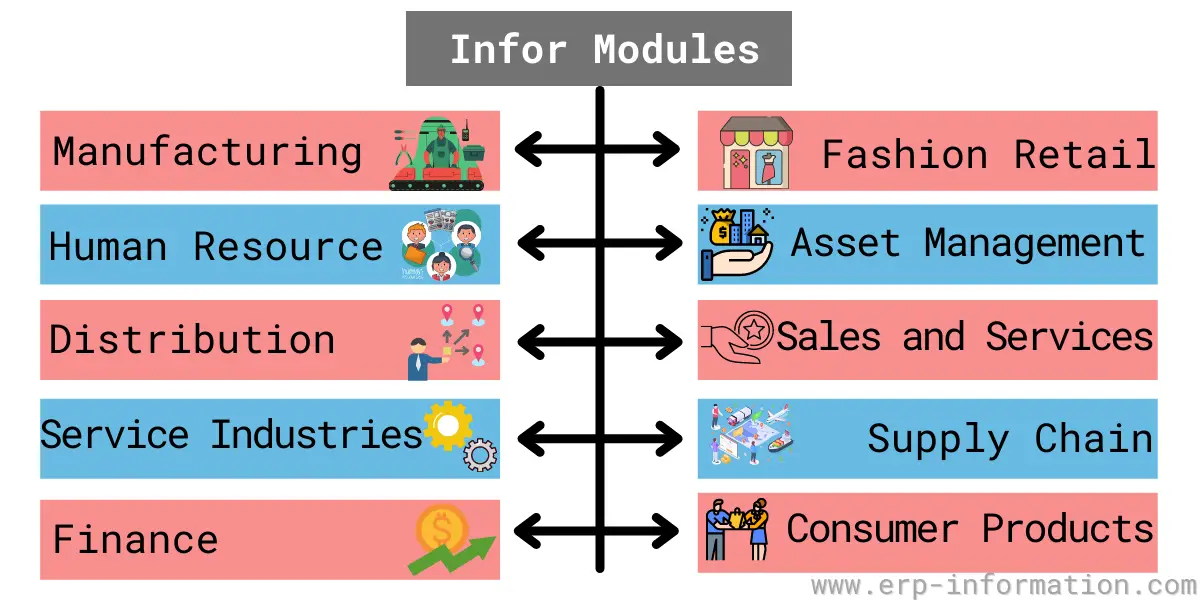
Manufacturing
- Cloudsuite Automotive
- Cloudsuite Aerospace and Defense
- Cloudsuite Chemicals
- Cloudsuite Industrial Enterprise
- Cloudsuite Industrial (Syteline)
Human Resource
- HR Benefits & Compensation, Payroll Management and Talent Science
- Workforce Scheduling and Time & Attendance
Distribution
- Cloudsuite Distribution Enterprise
- Cloudsuite Distribution
- Cloudsuite Equipment
Service Industries
- CloudSuite Healthcare
- CloudSuite Public Sector
- Financials & Supply Management (FSM)
Finance
- Financials & Supply Management (FSM)
- SunSystems Cloud
- Expense Management
Fashion and Retail
- CloudSuite Fashion
- PLM for Fashion
- Point-of-Sale (POS)
Asset Management
- Infor sold its global EAM business to Hexagon, which completed the acquisition on 1 October 2021, so enterprise asset management is no longer an Infor product line.
Sales and Services
- CRM
- Configure Price Quote
- Professional Services Automation
Supply Chain
- SCM
- WMS
Consumer Products
What arrived in the most recent releases:
- ESG Environmental Reporting: Infor’s data fabric consolidates data into a single source, providing both top-down and bottom-up insights and metrics for comprehensive analysis. Infor now includes ESG in its CloudSuites for Distribution and for Food & Beverage, with dashboards and templates designed to help generate audit-ready metrics.
- Modernized User Interface: It helps you work more efficiently and improves productivity. Less white space and lighter colors help to reduce scrolling and increase readability.
- Infor Velocity Suite: launched in 2025, this is the packaging for Infor’s AI work. It bundles GenAI, process mining, automation, AI agents and the Infor Value+ catalogue of prebuilt industry solutions, sold as a flat-fee package that pairs with every Infor CloudSuite.
- Industry AI agents and the Agentic Orchestrator: the 2026.04 release took the agent library past 100 agents and enhanced the Agentic Orchestrator, which coordinates agents across multi-step workflows using supervisor-led coordination and native Model Context Protocol connectivity. It also added observability into agent reasoning before production deployment, which matters if you intend to let agents touch live transactions. Infor says these orchestrator enhancements are in limited availability.
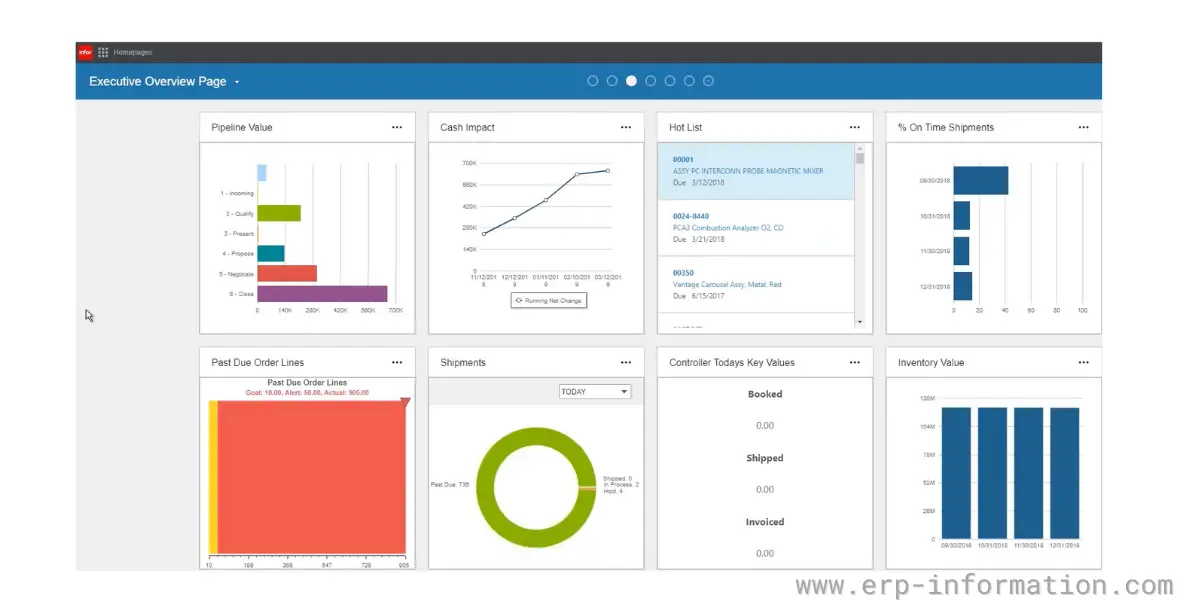
Some Screenshots of Infor
Infor Advantages
Achieve greater visibility across the business
It provides a comprehensive view of all aspects of the business, from development and production to delivery and fulfillment. This gives companies the ability to make better decisions based on accurate data.
Streamline supply chain processes
It streamlines supply chain processes with production planning and execution features, demand forecasting, supplier relationship management (SRM), etc. This can help businesses save time and money.
Enhances productivity
Clients are distributors, manufacturers, or any other type of industry, which gives them the potential to respond quickly to changes.
It allows the organizations to do a smooth process by providing suitable solutions for minor issues.
Facilitates tools for good management
For any organization, smoothly managing its process is a big challenge. So for that organization requires different tools.
It provides proper tools to plan resources, plan executions, and schedule. Hence encourages the organization to manage its processes.
Easy-to-use layouts
Screen layouts are unstained, functional, and compatible to use.
Some additional benefits are
- Multiple people can access it at the same time
- Easy to run and download the reports
- Helpful in filing GST
- Easy to track work orders
- Easy to access customer profile
Limitations
Following limitations that businesses should be aware of before implementing the software:
The system can be challenging to customize
It is highly customizable, but businesses may need to hire a consultant to use the software the most.
The system can be challenging to learn
It can present a learning curve, especially for users who aren’t familiar with ERP systems, making it a bit challenging to grasp initially.
The system can be expensive
It doesn’t come at the most budget-friendly price among ERP systems available, which might pose a challenge for small businesses due to its cost.
Not all modules are included in the standard package
Businesses must purchase additional modules or upgrade their license to access all features.
Though it provides many features, you need to have some add-on packages for detailed purchasing and account payable features.
The user interface needs improvement.
Infor ERP software has an outdated user interface that is not as intuitive as other systems on the market.
Users can only use CRM with ERP
Businesses might find themselves obliged to purchase both systems exclusively from Infor, lacking the option to combine products from various vendors.
Incompatibility issues between versions of software
The real version problem is not two editions of one product, it is the gap between an older on-premise install and current CloudSuite. Organisations running a heavily customised on-premise M3 or LN often find that their modifications have no direct equivalent in multi-tenant cloud, where you cannot alter the core code and must rebuild the customisation as an extension.
Companies that acquired their way to several Infor systems hit a related issue: an M3 site and an LN site are separate products, so consolidating them is a migration project, not a configuration exercise.
The customer support is slow to respond
In certain instances, businesses mention that their customer support team takes over 24 hours to respond when they reach out via call or email regarding system issues.
Some additional limitations are:
- Implementation of the software is a complex process.
- Cost is high for small companies.
- Need to open more than one page to view site locations.
What industries does it support?
It supports the following industries.
Manufacturing
- Aerospace and Defense
- Automotive
- Chemicals
- Construction & Engineering
- High Tech & Electronics
- Industrial Manufacturing
Consumer
- Fashion
- Food and Beverage
- Retail
Distribution
- Wholesale Distribution
- Equipment Dealers
- Logistics Service Providers
Public Sector
- Defense
- Federal Government
- K-12 Education
- State and Local Government
Energy and Natural Resources
- Oil and Gas
- Utilities
Healthcare
- Healthcare Institutions
Hospitality
- Casinos and Gaming
- Hotels and Resort
- Restaurants & food services
Infor Services Industries
- Banking & Financial Services
- Professional Services
- Transportation Service Providers
Infor Alternatives
- IFS Cloud: the closest competitor to LN. Same asset-intensive, service-heavy territory, and the one most often shortlisted against Infor in aerospace, energy, and field service.
- Epicor Kinetic: competes directly with CloudSuite Industrial in mid market discrete manufacturing, at a similar price point.
- SAP S/4HANA: the enterprise alternative for large multinational manufacturers, generally at higher cost and longer implementation than LN.
- NetSuite: stronger on financials and distribution, weaker on deep process manufacturing. A realistic alternative to CloudSuite Distribution, less so to M3 for food or chemicals.
- Microsoft Dynamics 365 Business Central: the mid market option where a Microsoft stack already exists. Note that Business Central, not Dynamics GP, is the current product; GP has been closed to new customers since April 2026.
- Acumatica: consumption-based licensing instead of per user, which changes the economics for companies with many light users.
- Odoo and SAP Business One: both sit well below Infor’s weight class and are only worth comparing if you are smaller than Infor’s realistic floor.
Customers
Infor says LN alone supports more than 1,500 discrete manufacturing customers. Its published customer stories include Reynolds Catering, a UK fresh produce supplier, on M3, and Pilot Flying J. Reference lists like this are supplied by the vendor and are rarely dated, so treat them as evidence that the product works at that scale rather than proof any named company is still a customer today.
One name that circulates on competitor lists is worth correcting: Avaap was an Infor systems integrator, not an Infor end customer; it sold its Infor consulting business to ASGN in 2021.
Infor VS Oracle
Infor and Oracle Cloud ERP are two prominent players in the enterprise resource planning (ERP) landscape, each with its unique features and strengths. Here is the comparison of both ERP solutions.
Oracle offers a comprehensive suite of integrated Software as a Service (SaaS) applications spanning finance, HR, supply chain, sales, marketing, and service.
It consolidates data into analytics and Enterprise Performance Management (EPM) applications and provides rapid insights That empower users to make informed decisions.
In contrast, Infor, while boasting a broad portfolio with a stronghold in manufacturing and distribution, tends to focus on functional capabilities tailored to past business needs.
For industries and business sectors like sales, marketing, and customer service, sophisticated requirements may necessitate integration with external systems or collaborative development with Infor.
FAQs
Is Infor ERP the same thing as Infor M3?
No. Infor M3 is one of several ERPs Infor sells, alongside LN, SyteLine and Financials & Supply Management (FSM). Infor ERP is a loose umbrella term, not a product you can buy. Infor positions M3 for fashion, food and beverage, chemicals, distribution, industrial manufacturing and equipment companies, and runs it as a multi-tenant cloud ERP on AWS.
Who owns Infor?
Koch Industries. Koch first invested in Infor in 2017 and completed its purchase of the remaining portion of Infor from Golden Gate Capital on 31 March 2020. In Infor’s 2019 annual report, Koch Industries held 45 percent of Infor’s common stock and Golden Gate Capital 55 percent. Infor operates as a standalone Koch subsidiary headquartered in Atlanta, Georgia, so it is privately held and does not report quarterly results the way SAP, Oracle, or Microsoft do.
How much does Infor CloudSuite cost?
Infor publishes no list price. Partner quotes put licenses at roughly $100 to $350 per user per month depending on edition, assuming 100 to 500 named users. Implementation is the bigger cost at $200,000 to $600,000 for a mid market deployment and $1M or more for large enterprise. A 300 user deployment typically totals $800,000 to $1.8M over three years.
What language is Infor M3 written in?
The M3 server is written in Java, which is part of why it has run across a wide range of operating systems and hardware over its life. In its current form M3 is delivered as a multi-tenant cloud application on AWS rather than something you install and run yourself.
Can you still run Infor on-premise?
Existing on-premise installations of M3, LN, and SyteLine remain supported, and Infor’s public site gives no end-of-support date for them. But new sales are multi-tenant cloud, and new features and AI capabilities are cloud first or cloud only, so on-premise deployments fall progressively further behind on functionality even while support continues.
Conclusion
Infor is strongest where it is specific. In process manufacturing, fashion, and asset-intensive discrete industries, M3 and LN carry functionality (recipe and formula handling, catch weight, shelf life, earned value management, regulated compliance) that generalist ERP vendors treat as an add on or leave to a third party. That depth, built on accurate data, is the reason to shortlist it.
The weaknesses are equally specific. Pricing is opaque and requires an RFP before you learn anything useful. Implementation dominates the budget and routinely overruns on data migration and integration. Customisation on multi-tenant cloud is constrained in ways that on-premise veterans find frustrating. And Infor is a poor fit below roughly 100 users regardless of which edition a rep proposes.
The single most useful thing a buyer can do is settle the engine question first. Establish whether your requirements point to M3, LN, SyteLine or FSM before you take a demo, because a demo of the wrong engine will look impressive and tell you nothing.
References:
Using Google Search? Add erp-information.com as a preferred source.