QAD Adaptive ERP is sold by private quote, not by published plan. QAD has never published a list price for it. The last audited figures QAD filed with the SEC, before Thoma Bravo took the company private in November 2021, imply a blended subscription cost of roughly $123 to $137 per user per month across the four user classes QAD actually meters.
That range is derived on this page from QAD’s own Form 10-K rather than taken from a vendor rate card, because no rate card exists. The sections below show the calculation, the contract terms QAD disclosed to its regulator, and what genuinely moves a QAD quote.
QAD ERP is a comprehensive, cloud-based ERP system that offers features to help businesses streamline their operations. With QAD ERP, you can manage your accounting, inventory, production, sales and marketing, customer relationship, and project management from one central platform.
Click here for similar kinds of Cloud ERP Software
Current release: QAD Adaptive with Champion AI, QAD’s agentic AI layer, launched in November 2025 and available globally.
Ownership: QAD has been privately held by Thoma Bravo since the $2 billion take-private completed in November 2021. It files no public accounts, so the fiscal 2021 Form 10-K below is the last audited pricing evidence that exists.
What Factors Influence the QAD ERP Pricing?
Many factors influence the pricing. Some of these include the size and complexity of the implementation, the number of users, the level of customization required, and whether or not you need to hire a consultant to help with the implementation.
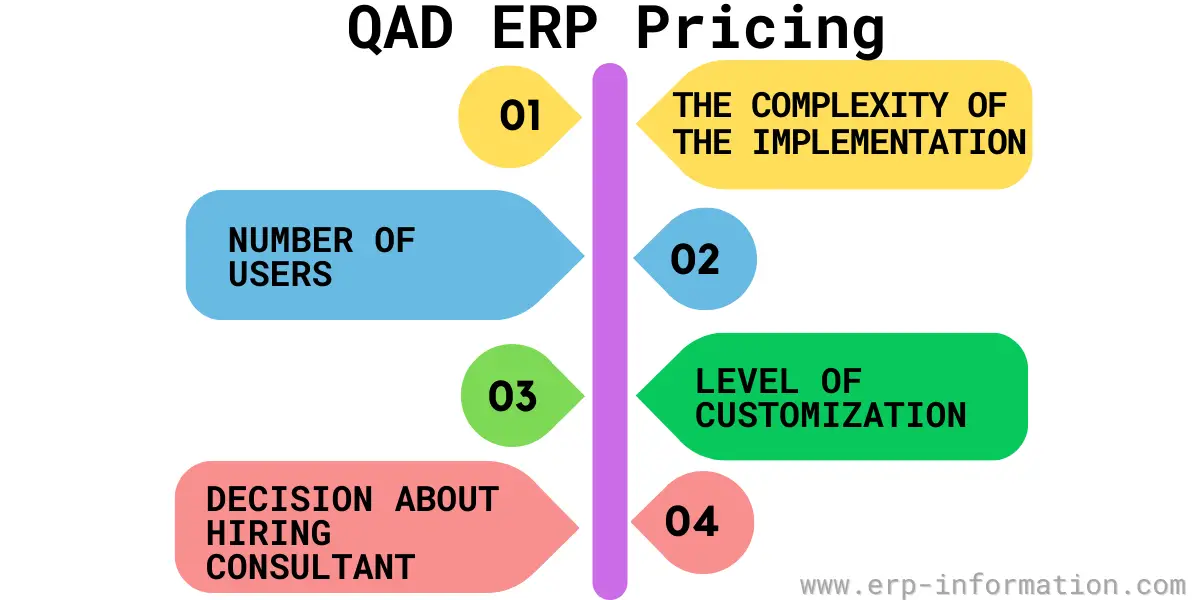
- Size and complexity of the implementation- The more complex the implementation, the higher the cost. For example, if you need to track and manage more inventory items, this would require a more complex implementation.
- The number of users- The more users you have, the higher the cost. You may need to purchase an additional license if you have many users.
- Level of customization- This will add to the cost if you need to customize the software to fit your specific business needs.
- The Decision about hiring a consultant– If you don’t have the internal resources to handle the implementation, you will need to budget for the cost of a consultant.
Generally, larger companies will have a higher implementation cost than smaller ones, and organizations requiring more customization will also have a higher implementation cost.
It’s important to remember that every organization is different, so it isn’t easy to give an exact estimate without knowing more about your specific needs.
QAD Pricing Models
QAD sells on two commercial models, not three: a cloud subscription and a legacy perpetual license carrying annual maintenance. A usage or transaction-based meter is sometimes attributed to QAD, but QAD has never documented one, and its own revenue disclosure records only subscription, license, maintenance and professional services. Its fiscal 2021 revenue split shows how far the subscription model had already displaced the perpetual one.
| QAD revenue line, fiscal 2021 | Amount | Share of revenue | Change on prior year |
|---|---|---|---|
| Subscription (cloud, the model QAD sells today) | $131,133,000 | 43% | up 22% |
| Maintenance (support on existing perpetual licenses) | $107,083,000 | 35% | down 9% |
| Professional services (implementation and consulting) | $58,497,000 | 19% | down 15% |
| License (new perpetual sales) | $11,152,000 | 3% | down 33% |
| Total revenue | $307,865,000 | 100% | down 1% |
Subscription Plans
QAD does not sell named plans. There is no Basic, Professional or Enterprise edition of QAD Adaptive ERP, and QAD’s own product pages name none. What QAD actually meters is user class multiplied by module. In its fiscal 2021 Form 10-K QAD identified four classes by name:
“In fiscal 2021 our subscription users, including full users, limited users, enterprise users and module users, grew by 25% to 89,000, from 71,000 in the prior year.”
QAD Inc., Form 10-K for the fiscal year ended 31 January 2021
This is the single most useful thing to know before a QAD call. A quote is assembled by counting how many people need each class, so the first question to answer internally is not how many employees you have but how many of them need full transactional access rather than occasional or single-module access.
| What QAD counts | What it means for your quote |
|---|---|
| Full users | Unrestricted transactional access. The most expensive class and the one to keep smallest. |
| Limited users | Restricted access for occasional or read-mostly roles. Moving a name from full to limited is the usual way a quote comes down. |
| Enterprise users | Access scoped across the enterprise deployment rather than to a single site. |
| Module users | Access to one functional module only, for example quality management or field service. |
QAD Contract Terms You Should Know Before Negotiating
QAD is unusually quiet about price but was obliged to describe its contract mechanics to the SEC. Three disclosures matter to a buyer, and none of them appear on competing pricing pages.
| Disclosure | QAD’s own wording | Why it matters |
|---|---|---|
| Initial term is long | “Our cloud customers typically enter into subscription agreements with an initial term of 24 to 60 months.” | A QAD subscription is a two to five year commitment, so the per-user rate is only part of the number. Multiply by the term before comparing. |
| QAD discounts under pressure | “We are occasionally obliged to offer deep discounts and other favorable terms in order to match or exceed the product and service offerings of our competitors.” | QAD told its regulator that competitive pressure moves its price. A credible, documented alternative is the strongest lever a buyer has. |
| You can shrink at renewal | “Our cloud customers have the option to renew a lower number of users and/or a reduced number of modules.” | Over-buying at signature is recoverable at renewal. QAD lists this as a revenue risk to itself, which confirms customers use it. |
| Downtime earns credit | QAD is “obligated under our standard customer contracts to issue one day’s credit against future fees for each hour of system unavailability.” | A standard availability remedy already exists. Check it is in your contract rather than negotiating it from scratch. |
How much does the QAD Charge?
| Step | Input or result | Where it comes from |
|---|---|---|
| Subscription revenue, fiscal 2021 | $131,133,000 | QAD Form 10-K, audited |
| Subscription users at year end | 89,000 | QAD Form 10-K |
| Subscription users a year earlier | 71,000 | QAD Form 10-K |
| Revenue divided by year-end users | $1,473 per user per year | Calculated here |
| Revenue divided by mid-year average users (80,000) | $1,639 per user per year | Calculated here |
| Implied blended cost | $123 to $137 per user per month | Calculated here |
Read that range for what it is. It is a blended average across all four user classes, so a full user costs more than $137 and a module user costs less. It is also fiscal 2021 data, which is simply the most recent audited data that exists, because QAD stopped filing public accounts when Thoma Bravo took it private later that year. It is an anchor for a negotiation, not a quote.
On implementation cost, this page abstains. QAD does not publish implementation fees, and the ranges circulating elsewhere are untraceable to any source. What can be said from QAD’s audited accounts is the ratio: in fiscal 2021 QAD earned $58,497,000 in professional services against $131,133,000 in subscription revenue. Across QAD’s whole book, services billings ran at roughly 45% of subscription revenue, which is a defensible starting assumption for budgeting where an invented dollar range is not.
There is no minimum user count on record. QAD publishes none, and this page will not invent one.
Some Cost-saving Tips for QAD ERP
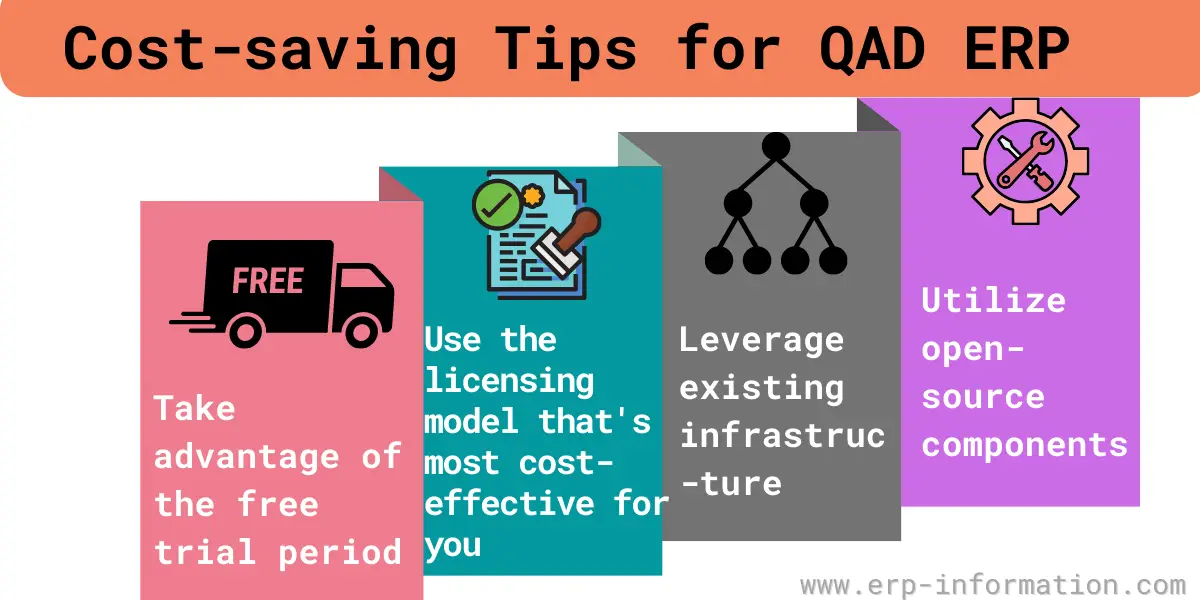
- Right-size the user classes before you are quoted: QAD meters full, limited, enterprise and module users separately. Counting how many people genuinely need full transactional access, rather than quoting everyone as a full user, is the largest single lever on the number you are given.
- Do not over-buy at signature: QAD records as a risk to its own revenue that “our cloud customers have the option to renew a lower number of users and/or a reduced number of modules.” Buying tightly and adding later costs less than buying wide and waiting for a renewal to correct it.
- Price the whole term, not the monthly rate: QAD states its cloud agreements run an initial 24 to 60 months. A rate that looks competitive monthly is a commitment of two to five years, so compare total contract value against alternatives rather than headline per-user figures.
- Bring a documented alternative to the table: QAD disclosed to the SEC that it is “occasionally obliged to offer deep discounts and other favorable terms in order to match or exceed the product and service offerings of our competitors.” A real, costed competing quote is the lever QAD itself says moves its price.
QAD ERP system Pricing Comparisons
Comparing QAD on price is harder than comparing most of its rivals, because the manufacturing ERP market is split between vendors who publish a rate card and vendors who do not. QAD is firmly in the second group. Checked directly on each vendor’s own site in September 2026:
| Vendor | Publishes a list price? | What you can see before contact |
|---|---|---|
| QAD Adaptive ERP | No | No pricing page exists on qad.com. Its AWS Marketplace listing carries a placeholder rate and states “pricing is based on the duration and terms of your contract with the vendor.” |
| Microsoft Dynamics 365 Business Central | Yes | Essentials $80, Premium $110 and Team Members $8 per user per month, billed yearly, published openly. |
The practical consequence is that QAD cannot be shortlisted on price alone. A like-for-like comparison needs a quote built on the same user counts, the same modules and the same contract length, plus implementation, which on QAD’s own accounts runs near 45% of subscription value. Total cost of ownership over the committed term is the only figure that compares cleanly.
User Reviews
Treat the per-user figures on review and comparison sites with care. Because QAD publishes nothing, those sites fill the gap with their own estimates, and the estimates disagree with each other. One widely ranked QAD pricing page seen in September 2026 headlines “from $90/user/mo” and then gives a range of $150 to $300 per user per month on the same page, without citing a source for either figure.
That is not dishonesty so much as the predictable result of a vendor who discloses nothing. It does mean a number found on an aggregator carries no more authority than the person who typed it. The $123 to $137 range on this page is different only in that you can check it: the two inputs are line items in a filing QAD signed and submitted to the SEC, and the arithmetic is shown above.
This page deliberately publishes no star rating for QAD. The major review platforms block automated access, and a rating that cannot be verified at its source today is not worth repeating.
FAQs
How much does QAD Adaptive ERP cost per user?
QAD does not publish a price. Its last audited accounts, the fiscal 2021 Form 10-K, report $131,133,000 of subscription revenue across 89,000 subscription users, which implies a blended $1,473 to $1,639 per user per year, or roughly $123 to $137 per user per month. That is an average across QAD’s four user classes, so a full user costs more and a module user less.
Does QAD publish a price list?
No. There is no pricing page on qad.com, and QAD’s AWS Marketplace listing shows a placeholder rate with the note that pricing depends on the duration and terms of your contract. Every per-user figure published elsewhere is an estimate made by a third party, not a QAD rate card.
How long is a QAD contract?
QAD told the SEC that its cloud customers typically enter into subscription agreements with an initial term of 24 to 60 months. Customers may renew a lower number of users or modules at the end of that term, so buying tightly and expanding later is cheaper than over-buying at signature.
Does QAD offer a free trial?
No. QAD does not offer a free trial of Adaptive ERP. Evaluation is by vendor-led demonstration and a private quote arranged with QAD or an authorised partner.
Conclusion
QAD Adaptive ERP has no published price, and any page that gives you one without showing its working is guessing. The defensible summary is narrow: QAD meters four classes of user against the modules you license, it commits you for 24 to 60 months, it concedes that competitive pressure makes it discount, and its last audited accounts imply a blended cost near $123 to $137 per user per month in fiscal 2021.
Take those four facts into the first call and ask QAD to quote per user class, per module, at the term you actually want. That is a materially better position than asking what it costs.
How We Calculated These Figures
Checked and calculated on 20 September 2026. QAD’s fiscal 2021 Form 10-K, covering the year ended 31 January 2021, is the last audited disclosure QAD made before Thoma Bravo completed its take-private in November 2021, and it is the source for every QAD figure on this page.
- The revenue table is quoted from the filing without adjustment. Its four lines sum to the stated total of $307,865,000, which is the internal check that the figures were read correctly.
- The per-user range divides subscription revenue by the subscription user count, shown both at year end (89,000) and at the mid-year average (80,000), because the base grew 25% during the year and a single divisor would mislead.
- The services ratio divides professional services revenue by subscription revenue, both from the same filing.
- Vendor pricing pages were requested directly in September 2026. QAD returns no pricing page; Microsoft publishes list prices, which are reproduced as found.
- No implementation fee, minimum user count or star rating is published here, because none could be traced to a primary source. Where QAD discloses nothing, this page says so rather than estimating.
Sources:
- QAD Inc., Form 10-K for the fiscal year ended 31 January 2021, U.S. Securities and Exchange Commission. Source for the revenue table, the four user classes, the 89,000 subscription user count, the 24 to 60 month contract term, the discounting disclosure and the renewal reduction right.
- Thoma Bravo Completes Acquisition of QAD, November 2021. Source for the $2 billion take-private that ended QAD’s public reporting.
- QAD Champion AI, qad.com. Source for the current release of QAD Adaptive and its agentic AI layer.
- QAD Adaptive ERP on AWS Marketplace. Source for the private-offer pricing model.
- Microsoft Dynamics 365 Business Central pricing. Source for the published comparison prices.